Sunday, March 6, 2016

University of California, Berkeley

                                                                                                                                                                                                                                                                                                                                            
  Not to be confused with Berkeley College, Berkeley College (Yale University), or Berklee College of Music.
University of California, Berkeley
Seal of University of California, Berkeley.svg
Seal of the University of California, Berkeley
Motto Fiat lux (Latin)
Motto in English
Let there be light
Type Flagship
Public research university
Land Grant
Established March 23, 1868
Endowment $4.045 billion (2015)
Chancellor Nicholas Dirks
Students 37,581 (Fall 2014)[3]
Undergraduates 27,126 (Fall 2014)
Postgraduates 10,455 (Fall 2014)
Location Berkeley, California, U.S.
Campus
Urban
Total 1,232 acres (499 ha) Core Campus 178 acres (72 ha)

Total land owned 6,679 acres (2,703 ha)
Yearbook The Blue & Gold
Colors Berkeley Blue & California Gold[6]
       
Athletics NCAA Division I – Pac-12
Sports 27 varsity teams
Nickname Golden Bears
Mascot Oski the Bear
Affiliations
University of California system, AAU, IARU, URA, APRU, APLU
Website www.berkeley.edu
Logo of the University of California, Berkeley.svg
The University of California, Berkeley (also referred to as Berkeley, UC Berkeley, California or simply Cal) is a public research university located in Berkeley, California. It is the flagship campus of the University of California system, one of three parts in the state's public higher education plan, which also includes the California State University system and the California Community Colleges System.

It is considered by the Times Higher Education World University Rankings as one of six university brands that lead in world reputation rankings in 2015 and is ranked third on the U.S. News' 2015 Best Global Universities rankings conducted in the U.S. and nearly 50 other countries.The Academic Ranking of World Universities (ARWU) also ranks the University of California, Berkeley fourth in the world overall, and first among public universities. It is broadly ranked first in science, third in engineering, and fifth in social sciences, with specific rankings of first in chemistry, first in physics, third in computer science, fourth in mathematics, and fourth in economics/business. The university is also well known for producing a high number of entrepreneurs.

Established in 1868 as the result of the merger of the private College of California and the public Agricultural, Mining, and Mechanical Arts College in Oakland, UC Berkeley is the oldest institution in the UC system and offers approximately 350 undergraduate and graduate degree programs in a wide range of disciplines. The University of California has been charged with providing both "classical" and "practical" education for the state's people. Cal co-manages three United States Department of Energy National Laboratories, including the Los Alamos National Laboratory, Lawrence Livermore National Laboratory and Lawrence Berkeley National Laboratory for the U.S. Department of Energy.

Berkeley faculty, alumni, and researchers have won 72 Nobel Prizes (including 30 alumni Nobel laureates), nine Wolf Prizes, eight Fields Medals (including 3 alumni medalists), 20 Turing Awards, 45 MacArthur Fellowships, 20 Academy Awards,11 Pulitzer Prizes and 105 Olympic gold medals (47 silver and 33 bronze). To date, UC Berkeley scientists have discovered six chemical elements of the periodic table (californium, seaborgium, berkelium, einsteinium, fermium, lawrencium). Along with Berkeley Lab, UC Berkeley researchers have discovered 16 chemical elements in total – more than any other university in the world. Berkeley is a founding member of the Association of American Universities and continues to have very high research activity with $730.7 million in research and development expenditures in the fiscal year ending June 30, 2014.

Contents :

1 History
1.1 1866 - 2014
1.2 Funding
1.3 Name
2 Academics
2.1 Undergraduate programs
2.2 Graduate and professional programs
2.3 Faculty and research
2.4 Library system
2.5 Rankings and reputation
2.5.1 Global
2.5.2 National
3 Campus
3.1 Architecture
3.2 Natural features
3.3 Environmental record
4 Organization and administration
4.1 University finances
4.1.1 Financial aid and scholarship programs
5 Admissions and enrollment
6 Student life and traditions
6.1 Student housing
6.1.1 University housing
6.1.2 Cooperative housing
6.1.3 Fraternities and sororities
6.2 Student-run organizations
6.2.1 Student government
6.2.2 Communications media
6.2.3 Student groups
6.3 Athletics
6.3.1 California – Stanford rivalry
6.3.2 National championships
7 Notable alumni, faculty, and staff
7.1 Faculty
7.2 Alumni
8 See also
9 Notes and references
10 Further reading and viewing
11 External links


History:
View, from Memorial Glade, of Sather Tower (The Campanile), the center of UC Berkeley. The ring of its bells and clock can be heard from all over campus.
Main article: History of the University of California, Berkeley
1866 - 2014
In 1866, the private College of California purchased the land comprising the current Berkeley campus. Because it lacked sufficient funds to operate, it eventually merged with the state-run Agricultural, Mining, and Mechanical Arts College to form the University of California, the first full-curriculum public university in the state.

Ten faculty members and almost 40 students made up the new University of California when it opened in Oakland in 1869. Frederick H. Billings was a trustee of the College of California and suggested that the college be named in honor of the Anglo-Irish philosopher George Berkeley. In 1870, Henry Durant, the founder of the College of California, became the first president. With the completion of North and South Halls in 1873, the university relocated to its Berkeley location with 167 male and 222 female students and held its first classes.

Beginning in 1891, Phoebe Apperson Hearst made several large gifts to Berkeley, funding a number of programs and new buildings, and sponsoring, in 1898, an international competition in Antwerp, Belgium, where French architect Émile Bénard submitted the winning design for a campus master plan. In 1905, the University Farm was established near Sacramento, ultimately becoming the University of California, Davis. By the 1920s, the number of campus buildings had grown substantially, and included twenty structures designed by architect John Galen Howard.

Robert Gordon Sproul served as president from 1930 to 1958. By 1942, the American Council on Education ranked UC Berkeley second only to Harvard University in the number of distinguished departments.


UC Berkeley Students participate in a one-day Peace Strike opposing U.S. involvement in World War II. April 19, 1940
During World War II, following Glenn Seaborg's then-secret discovery of plutonium, Ernest Orlando Lawrence's Radiation Laboratory began to contract with the U.S. Army to develop the atomic bomb. UC Berkeley physics professor J. Robert Oppenheimer was named scientific head of the Manhattan Project in 1942.[28][29] Along with the Lawrence Berkeley National Laboratory (formerly the Radiation Lab), Berkeley is now a partner in managing two other labs, Los Alamo's National Laboratory (1943) and Lawrence Livermore National Laboratory (1952).

Originally, military training was compulsory for male undergraduates, and Berkeley housed an armory for that purpose. In 1917, Berkeley's ROTC program was established, and its School of Military Aeronautics trained future pilots, including Jimmy Doolittle, who graduated with a B.A. in 1922. Both Robert McNamara and Frederick C. Weyand graduated from UC Berkeley's ROTC program, earning B.A. degrees in 1937 and 1938, respectively. In 1926, future fleet admiral Chester W. Nimitz established the first Naval Reserve Officers Training Corps unit at Berkeley. During World War II, the military increased its presence on campus to recruit more officers, and by 1944, more than 1,000 Berkeley students were enrolled in the V-12 Navy College Training Program and naval training school for diesel engineering. The Board of Regents ended compulsory military training at Berkeley in 1962.

During the McCarthy era in 1949, the Board of Regents adopted an anti-communist loyalty oath. A number of faculty members objected and were dismissed; ten years passed before they were reinstated with back pay.

In 1952, the University of California became an entity separate from the Berkeley campus. Each campus was given relative autonomy and its own Chancellor. Then-president Sproul assumed presidency of the entire University of California system, and Clark Kerr became the first Chancellor of UC Berkeley.


Sather Tower (the Campanile) looking out over the San Francisco Bay and Mount Tamalpais.
Berkeley gained a reputation for student activism in the 1960s with the Free Speech Movement in 1964, and opposition to the Vietnam War. In the highly publicized People's Park protest in 1969, students and the school conflicted over use of a plot of land; the National Guard was called in and violence erupted. Then governor of California Ronald Reagan called the Berkeley campus "a haven for communist sympathizers, protesters, and sex deviants." Modern students at Berkeley are less politically active, with a greater percentage of moderates and conservatives.Democrats outnumber Republicans on the faculty by a ratio of 9:1.

Various human and animal rights groups have conflicted with Berkeley. Native Americans conflicted with the school over repatriation of remains from the Phoebe A. Hearst Museum of Anthropology. Animal-rights activists have threatened faculty members using animals for research. The school's response to tree sitters protesting construction caused controversy in the local community.

On May 1, 2014, UC Berkeley was named one of fifty-five higher education institutions under investigation by the Office of Civil Rights "for possible violations of federal law over the handling of sexual violence and harassment complaints" by the White House Task Force to Protect Students from Sexual Assault. The investigation comes after 31 female students made three federal complaints: first, a Clery Act complaint was filed in May 2013, and then, after a lack of response from the University, a second Clery Act Complaint and Title IX complaint were filed on February 26, 2014.

Funding
As state funding declined, Berkeley turned to private sources: BP donated $400 million over 10 years to develop biofuels, the Hewlett Foundation gave $113 million to endow 100 faculty chairs, and Dow Chemical gave $10 million to research sustainability. The BP grant has been criticized for diverting food production to fuel production. The 2008–13 Campaign for Berkeley raised $3.13 billion from 281,855 donors.

Name[edit]
The original name University of California was frequently shortened to California or Cal. UC Berkeley's athletic teams date to this time and so are referred to as the California Golden Bears, Cal Bears, or just Cal. Today, University of California refers to a statewide school system. Referring to the University of California, Berkeley as UCB or University of California at Berkeley is discouraged[51] and the domain name is berkeley.edu. Moreover, the term "Cal Berkeley" is not a correct reference to the school, but is occasionally used. Berkeley is unaffiliated with the Berklee College of Music or Berkeley College.

Academics[edit]
Berkeley is a large, primarily residential research university with a majority of enrollments in undergraduate programs but also offers a comprehensive doctoral graduate program.The university has been accredited by the Western Association of Schools and Colleges Senior College and University Commission since 1949. The university is one of only two UC campuses operating on a semester calendar, (the other is UC Merced). Berkeley offers 106 Bachelor's degrees, 88 Master's degrees, 97 research-focused doctoral programs, and 31 professionally focused graduate degrees.The university awarded 7,565 Bachelor's, 2,610 Master's or Professional, and 930 Doctoral degrees in 2013-14.

Berkeley's 130-plus academic departments and programs are organized into 14 colleges and schools in addition to UC Berkeley Extension.[4] "Colleges" are both undergraduate and graduate, while "Schools" are generally graduate only, though some offer undergraduate majors, minors, or courses.

College of Chemistry
College of Engineering
College of Environmental Design
College of Letters and Science
College of Natural Resources
Graduate School of Education
Graduate School of Journalism
Haas School of Business
Goldman School of Public Policy
School of Information
School of Law (Boalt Hall)
School of Optometry
School of Public Health
School of Social Welfare
UC Berkeley Extension
UC Berkeley does not have a medical school; however, the university offers the UC Berkeley – UCSF Joint Medical Program with the University of California, San Francisco, a standalone medical school that is located nearby.

Undergraduate programs[edit]
The four-year, full-time undergraduate program has a focus on the arts and sciences with a high level of co-existence in undergraduate and graduate programs. Freshman admission is selective but there are high levels of transfer-in.[52] 106 Bachelor's degrees are offered across the Haas School of Business (1), College of Chemistry (5), College of Engineering (20), College of Environmental Design (3), College of Letters and Science (67), College of Natural Resources (10), and other individual majors (2).[54] The most popular majors are Electrical Engineering and Computer Science, Political Science, Molecular and Cell Biology, Environmental Science, and Economics.[56]

Requirements for undergraduate degrees come from four sources: the University of California system, the Berkeley campus, the college or school, and the department. These requirements include an entry-level writing requirement before enrollment (typically fulfilled by minimum scores on standardized admissions exams such as the SAT or ACT), completing coursework on "American History and Institutions" before or after enrollment by taking an introductory class, passing an "American Cultures Breadth" class at Berkeley, as well as requirements for reading and composition and specific requirements declared by the department and school.[57] Three-hour final examinations are required in most undergraduate classes and take place over a week following the last day of instruction in mid-December for the Fall semester and in mid-May for the Spring semester.[58] Academic grades are reported on a five-letter scale (A,B,C,D,F) with grade points being modified by three-tenths of point for pluses and minuses.[59] Requirements for academic honors are specified by individual schools and colleges, scholarly prizes are typically awarded by departments, and students are elected to honor societies based on these organizations' criteria.[60]

Graduate and professional programs[edit]
Berkeley has a "comprehensive" graduate program with high coexistence with the programs offered to undergraduates, but no medical school.[52] The university offers graduate degrees in Master's of Art, Master's of Science, Master's of Fine Art, and Ph.D.s in addition to professional degrees such as the Juries Doctor and Master of Business Administration.[61] The university awarded 887 doctoral degrees and 2,506 Master's degrees in 2012.[62] Admission to graduate programs is decentralized; applicants apply directly to the department or degree program. Most graduate students are supported by fellowships, teach assistant ships, or research assistant ships.[62] The 2010 United States National Research Council Rankings identified UC Berkeley as having the highest number of top-ranked doctoral programs in the nation.[63] UC Berkeley doctoral programs that received a #1 ranking include Agricultural and Resource Economics, Astrophysics, Chemistry, Civil and Environmental Engineering, Computer Science, English, Epidemiology, Geography, German, Mathematics, Mechanical Engineering, Biochemistry and Molecular Biology, Genetics, Genomics, and Development, Physics, Plant Biology, and Political Science. UC Berkeley was also the #1 recipient of National Science Foundation Graduate Research Fellowships between 2001 and 2010, with 1,333 awards.[62]

Faculty and research[edit]
Main articles: List of UC Berkeley faculty, Research centers and laboratories at UC Berkeley and List of Nobel laureates associated with University of California, Berkeley

Seventy-two Nobel Laureates have been university faculty, alumni or researchers. Special signs indicate campus parking spaces reserved for the Laureates.
Berkeley is a research university with a "very high" level of research activity. In 2013 Berkeley spent $727 million on research and development (R&D).[64] There are 1,620 full-time and 500 part-time faculty members dispersed among more than 130 academic departments and more than 80 interdisciplinary research units.[65] Berkeley's current faculty includes 235 American Academy of Arts and Sciences Fellows, 3 Fields Medal winners, 77 Fulbright Scholars, 139 Guggenheim Fellows, 73 members of the National Academy of Engineering, 144 members of the National Academy of Sciences, 7 Nobel Prize winners, 4 Pulitzer Prize winners, 125 Sloan Fellows, 7 Wolf Prize winners and 1 Pritzker Prize winner. 72 Nobel laureates have been affiliated with the university as faculty, alumni or researchers, the most of any public university in the United States and sixth most of any university in the world.[citation needed]

Faculty at UC Berkeley are more likely to be registered Democrats than Republicans; this is similar to findings at Stanford University.

Library system

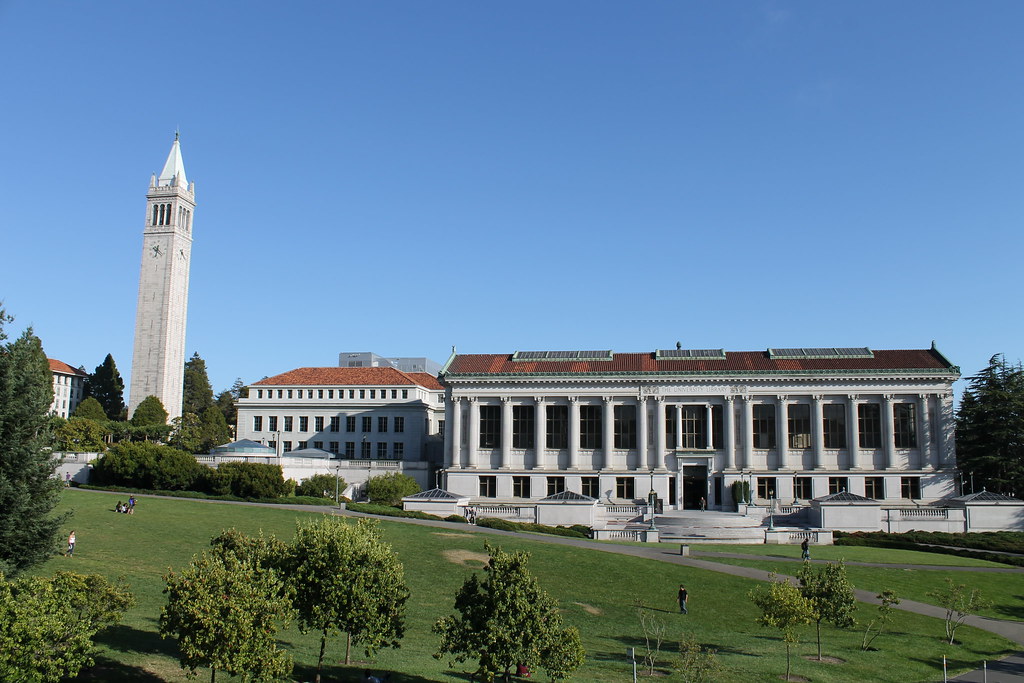
The north side of Doe Library with Memorial Glade in the foreground.
Main article: University of California, Berkeley Library System
Berkeley's 32 libraries tie together to make the fourth largest academic library in the United States surpassed only by Harvard University Library, Yale University Library and University of Illinois at Urban-Champaign Library. However, considering the relative sizes and ages of these University libraries, Berkeley's collections have been growing about as fast as those at Harvard and Yale combined: specifically, 1.8 times faster than Harvard, and 1.9 times faster than Yale. In 2003, the Association of Research Libraries ranked it as the top public and third overall university library in North America based on various statistical measures of quality. As of 2006, Berkeley's library system contains over 11 million volumes and maintains over 70,000 serial titles. The libraries together cover over 12 acres (4.9 ha) of land and form one of the largest library complexes in the world. Doe Library serves as the library system's reference, periodical, and administrative center, while most of the main collections are housed in the subterranean Gardner Main Stacks and Moffitt Undergraduate Library. The Bancroft Library, with holdings of over 400,000 printed volumes, maintains a collection that documents the history of the western part of North America, with an emphasis on California, Mexico and Central America.

Rankings and reputation
University rankings
National
ARWU 4
Forbes 35
U.S. News & World Report 20
Washington Monthly 4
Global
ARWU[77] 4
QS[78] 26
Times 13
Global
The Times Higher Education World University Rankings for 2015–2016 ranks Berkeley 13th in the world for academics and 6th in the world for reputation. In its 2016 edition, U.S. News & World Report ranked Berkeley 3rd in their "Best Global University Rankings".In 2015, Berkeley was ranked 4th in the world by the Academic Ranking of World Universities (ARWU)[10] and 26th in the QS World University Rankings.The Center for World University Rankings (CWUR) ranked the university 7th in the world based on quality of education, alumni employment, quality of faculty, publications, influence, citations, broad impact, and patents in 2015.

National[edit]
The 2016 U.S. News & World Report "Best Colleges" report ranked Berkeley first among public universities and 20th among national universities. The Washington Monthly ranked Berkeley fourth among national universities in 2015, with criteria based on research, community service, and social mobility. The Money Magazine Best Colleges ranking for 2015 ranked Berkeley 9th in the United States based on educational quality, affordability and alumni earnings. For 2015 Kiplinger ranked Berkeley the 4th best-value public university in the nation for in-state students, and 6th for out-of-state students. The 2015 Forbes America's Top Colleges report ranked Berkeley 35th among all universities and liberal arts colleges in the United States.

In 2014, The Daily Beast's Best Colleges report ranked Berkeley 11th in the country. The 2013 Top American Research Universities report by the Center for Measuring University Performance ranked Berkeley 8th over-all, 5th in resources, faculty, and education, 9th in resources and education, and 1st in education. Berkeley was listed as a "Public Ivy" in Richard Mull's 1985 Public Ivies.[89]

Campus[edit]
Main article: Campus of the University of California, Berkeley
The Berkeley campus encompasses approximately 1,232 acres (499 ha), though the "central campus" occupies only the low-lying western 178 acres (72 ha) of this area. Of the remaining acres, approximately 200 acres (81 ha) are occupied by the Lawrence Berkeley National Laboratory; other facilities above the main campus include the Lawrence Hall of Science and several research units, notably the Space Sciences Laboratory, the Mathematical Sciences Research Institute, an undeveloped 800-acre (320 ha) ecological preserve, the University of California Botanical Garden and a recreation center in Strawberry Canyon. Portions of the mostly undeveloped, eastern area of the campus are actually within the City of Oakland; these portions extend from the Claremont Resort north through the Panoramic Hill neighborhood to Tilden Park.

To the west of the central campus is the downtown business district of Berkeley; to the northwest is the neighborhood of North Berkeley, including the so-called Gourmet Ghetto, a commercial district known for high quality dining due to the presence of such world-renowned restaurants as Chez Panisse. Immediately to the north is a quiet residential neighborhood known as North-side with a large graduate student population; situated north of that are the upscale residential neighborhoods of the Berkeley Hills. Immediately southeast of campus lies fraternity row, and beyond that the Clark Kerr Campus and an upscale residential area named Claremont. The area south of the university includes student housing and Telegraph Avenue, one of Berkeley's main shopping districts with stores, street vendors and restaurants catering to college students and tourists. In addition, the University also owns land to the northwest of the main campus, a 90-acre (36 ha) married student housing complex in the nearby town of Albany ("Albany Village" and the "Gill Tract"), and a field research station several miles to the north in Richmond, California.

The campus is home to several museums including the University of California Museum of Paleontology, the UC Berkeley Art Museum and Pacific Film Archive, and the Lawrence Hall of Science. The Museum of Paleontology, found in the lobby of the Valley Life Sciences Building, showcases a variety of dinosaur fossils including a complete cast of a Tyrannosaurus Rex.

Outside of the Bay Area, the University owns various research laboratories and research forests in both northern and southern Sierra Nevada.


360-degree-view of the UC Berkeley campus
Architecture[edit]

South Hall (1873), one of the two original buildings of the University of California, still stands on the Berkeley campus
What is considered the historic campus today was the result of the 1898 "International Competition for the Phoebe Hearst Architectural Plan for the University of California," funded by William Randolph Hearst's mother and initially held in the Belgian city of Antwerp; eleven finalists were judged again in San Francisco in 1899.[92] The winner was Frenchman Émile Bénard, however he refused to personally supervise the implementation of his plan and the task was subsequently given to architecture professor John Galen Howard. Howard designed over twenty buildings, which set the tone for the campus up until its expansion in the 1950s and 1960s. The structures forming the "classical core" of the campus were built in the Beaux-Arts Classical style, and include Hearst Greek Theatre, Hearst Memorial Mining Building, Doe Memorial Library, California Hall, Wheeler Hall, (Old) Le Conte Hall, Gilman Hall, Haviland Hall, Wellman Hall, Sather Gate, and the 307-foot (94 m) Sather Tower (nicknamed "the Campanile" after its architectural inspiration, St Mark's Campanile in Venice). Buildings he regarded as temporary, nonacademic, or not particularly "serious" were designed in shingle or Collegiate Gothic styles; examples of these are North Gate Hall, Dwinelle Annex, and Stephens Hall. Many of Howard's designs are recognized California Historical Landmarks[93] and are listed on the National Register of Historic Places.

Built in 1873 in a Victorian Second-Empire-style, South Hall is the oldest university building in California. It, and the Frederick Law Olmsted-designed Piedmont Avenue east of the main campus, are the only remnants from the original University of California before John Galen Howard's buildings were constructed. Other architects whose work can be found in the campus and surrounding area are Bernard Maybeck[94] (best known for the Palace of Fine Arts in San Francisco), Maybeck's student Julia Morgan (Hearst Women's Gymnasium), Charles Willard Moore (Haas School of Business) and Joseph Esherick (Wurster Hall).

Natural features[edit]

The south fork of Strawberry Creek, as seen between Dwinelle Hall and Lower Sproul Plaza.
Flowing into the main campus are two branches of Strawberry Creek. The south fork enters a culvert upstream of the recreational complex at the mouth of Strawberry Canyon and passes beneath California Memorial Stadium before appearing again in Faculty Glade. It then runs through the center of the campus before disappearing underground at the west end of campus. The north fork appears just east of University House and runs through the glade north of the Valley Life Sciences Building, the original site of the Campus Arboretum.

Trees in the area date from the founding of the University in the 1870s. The campus, itself, contains numerous wooded areas; including: Founders' Rock, Faculty Glade, Grinnell Natural Area, and the Eucalyptus Grove, which is both the tallest stand of such trees in the world and the tallest stand of hardwood trees in North America.

The campus sits on the Hayward Fault, which runs directly through California Memorial Stadium. There is ongoing construction to retrofit the stadium. The "treesit" protest revolved around the controversy of clearing away trees by the stadium to build the new Student Athlete High Performance Center. As the stadium sits directly on the fault, this raised campus concerns of the safety of student athletes in the event of an earthquake as they train in facilities under the stadium stands.

Environmental record[edit]
Two committees and the Office of Sustainability and Energy at UC Berkeley work formally to implement sustainability initiatives on campus. The university encourages green purchasing when possible including installing energy-efficient technologies around campus such as steam trap systems and economizers.[98] UC Berkeley has a green building policy. Two buildings on campus are LEED certified, and six others meet LEED standards. Multiple building spaces have been re purposed for alternative use, and almost all waste from construction projects is diverted from landfills. Water conservation technologies have been installed across campus, and the university employs a variety of techniques to manage storm water.[98] UC Berkeley heats, cools, and powers its lab equipment utilizing power from an on-campus natural gas plant.[99] UC Berkeley's efforts toward sustainability earned the school a B on the College Sustainability Report Card; overall, the school's grades within the sections were high—it earned A's in the majority of the Report Card.

Organization and administration[edit]
The University of California is governed by a 26-member Board of Regents, 18 of which are appointed by the Governor of California to 12-year terms, 7 serving as ex officio members, a single student regent and a non-voting student regent-designate.The position of Chancellor was created in 1952 to lead individual campuses. The Board appointed Nicholas Dirks the 10th Chancellor of the university in 2013 after Robert J. Birgeneau, originally appointed in 2004, announced his resignation. 12 vice chancellors report directly to the Chancellor. The Executive Vice Chancellor and Provost serves as the chief academic officer and is the office to which the deans of the 14 colleges and schools report.


Haas School of Business
The 2006–07 budget totaled $1.7 billion; 33% came from the State of California. In 2006–07, 7,850 donors contributed $267.9 million and the endowment was valued at $2.89 billion.

UC Berkeley employs 24,700 people directly and employees are permitted to unionize and are represented by AFSCME, California Nurses Association (CNA), CUE-Teamsters Local 2010 (formerly the Coalition of University Employees (CUE)), UAW, UC-AFT, and UPTE.

University finances[edit]
See also: University of California finances
UC Berkeley receives funding from a variety of sources, including federal and state authorities, and private donors. With the exception of government contracts, public money is proportioned to UC Berkeley and the other 9 universities of the University of California system through the UC Office of the President.

State funding has, historically, been very high at the University of California. In 1987, the state provided 54% of the UC Berkeley's budget. However, due in part to the 2008–11 California budget crisis, recent educational appropriations to the university have seen a significant decline. State educational appropriations such as general support given in the state's annual budget, and appropriations given to the state through the federal American Reinvestment and Recovery Act (ARRA) dropped $37M in 2010–11 from the previous calendar year. In 2013, state general support dropped to 12% of the university's total revenues. State budget shortfalls as well as rising costs in pensions have been cited by the university as two of the leading reasons for its current financial woes. In response to revenue shortfalls, the UC Regents have raised tuition, and the university is trying to increase the number of non-resident undergraduates, who will pay the more costly out-of-state tuition. Nearly one-third of revenues from tuition and other student fees are returned to students as scholarships and fellowships.

Cal has controversially borrowed $445 million to fund the $321 million renovation of seismically unsafe Memorial Stadium and construction of a new $153 million student athletic center, both of which opened in 2012. (See Athletics section for additional details).

In 2014, Cal presented a plan to the Board of Regents that would create a venture capital fund that would fund student and faculty startups.

Financial aid and scholarship programs[edit]
See also: Student financial aid in the United States
Students and prospective students of UC Berkeley are eligible for a variety of public and private financial aid. Most[weasel words] financial aid inquiries are processed through the UC Berkeley Financial Aid and Scholarships Office. Some graduate schools, such as the Haas School of Business and UC Berkeley School of Law have their own financial aid offices.

Admissions and enrollment[edit]
Fall Freshman Profile
  2015 2014 2013 2012 2011 2010
Applicants
78,863
73,771
67,691
61,702
52,953
50,372
Admits
13,332
12,795
14,101
13,038
13,523
12,914
Admit rate
16.9%
17.3%
20.8%
21.1%
25.5%
25.6%
Enrolled
N/A
5,909
5,979
5,365
5,640
5,247
SAT range

N/A
1840-2230
1870-2240
1840-2240
1870-2230
1840-2230
ACT range

N/A
28-33
27-33
27-33
28-33
27-33
GPA (unweighted)

N/A
3.85
3.86
3.84
3.83
3.84
The Freshman Fall 2015 undergraduate acceptance rate at Berkeley was 16.9%. For Fall 2014, Berkeley enrolled 27,126 undergraduate and 10,455 graduate students, with women making up 52.1% of undergraduate enrollments and 45.2% graduate and professional students.California residents comprise 79% of Fall 2012 undergraduates and 40% of Fall 2013 graduate and professional students.

Of the Fall 2011 cohort, 97% of freshmen enrolled the next year. The four-year graduation rate for the Fall 2007 cohort was 61%, and the six-year rate was 88%. Enrolled freshman for the fall of 2014 had an average fully weighted high school GPA of 4.39 and an average unweighted GPA of 3.85. Fall 2014 admitted freshman applicants had an average ACT Composite score of 32–33, and average combined SAT scores of 2124 for in-state admits and 2171 for out-of-state admits.Berkeley's enrollment of National Merit Scholars was third in the nation until 2002, when participation in the National Merit program was discontinued.31% of admitted students receive federal Pell grants.

Demographics of student body (Fall 2014)[3][128]
Undergraduate Graduate California U.S. Census
Black 3.3% 3.7% 6.6% 13.1%
Asian 38.9% 17.9% 13.9% 5.1%
Non-Hispanic White 26.6% 38.8% 39.4% 63.0%
Hispanic (of any race) 13.5% 6.8% 38.2% 16.9%
Native American 0.7% 0.9% 1.7% 1.2%
International 13.5% 22.4% N/A N/A
Other/Unknown 3.5% 9.5% 4.1% 2.6%
Student life and traditions[edit]

Sather gate and Sather tower (the Campanile) from Sproul Plaza on the UC Berkeley campus
The official university mascot is Oski the Bear, who debuted in 1941. Previously, live bear cubs were used as mascots at Memorial Stadium. It was decided in 1940 that a costumed mascot would be a better alternative to a live bear. Named after the Oski-wow-wow yell, he is cared for by the Oski Committee, whose members have exclusive knowledge of the identity of the costume-wearer.

The University of California Marching Band, which has served the university since 1891, performs at every home football game and at select road games as well. A smaller subset of the Cal Band, the Straw Hat Band, performs at basketball games, volleyball games, and other campus and community events.

The UC Rally Committee, formed in 1901, is the official guardian of California's Spirit and Traditions. Wearing their traditional blue and gold rugbies, Rally Committee members can be seen at all major sporting and spirit events. Committee members are charged with the maintenance of the five Cal flags, the large California banner overhanging the Memorial Stadium Student Section and Haas Pavilion, the California Victory Cannon, Card Stunts and The Big "C" among other duties. The Rally Committee is also responsible for safekeeping of the Stanford Axe when it is in Cal's possession. The Chairman of the Rally Committee holds the title "Custodian of the Axe" while it is in the Committee's care.

Overlooking the main Berkeley campus from the foothills in the east, The Big "C" is an important symbol of California school spirit. The Big "C" has its roots in an early 20th-century campus event called "Rush," which pitted the freshman and sophomore classes against each other in a race up Charter Hill that often developed into a wrestling match. It was eventually decided to discontinue Rush and, in 1905, the freshman and sophomore classes banded together in a show of unity to build the Big "C".Owing to its prominent position, the Big "C" is often the target of pranks by rival Stanford University students who paint the Big "C" red and also fraternities and sororities who paint it their organization's colors. One of the Rally Committee's functions is to repaint the Big "C" to its traditional color of King Alfred Yellow.

Cal students invented the college football tradition of card stunts. Then known as Bleacher Stunts, they were first performed during the 1910 Big Game and consisted of two stunts: a picture of the Stanford Axe and a large blue "C" on a white background. The tradition continues today in the Cal student section and incorporates complicated motions, for example tracing the Cal script logo on a blue background with an imaginary yellow pen.

The California Victory Cannon, placed on Tightwad Hill overlooking the stadium, is fired before every football home game, after every score, and after every Cal victory. First used in the 1963 Big Game, it was originally placed on the sidelines before moving to Tightwad Hill in 1971. The only time the cannon ran out of ammunition was during a game against Pacific in 1991, when Cal scored 12 touchdowns.

Other traditions have included events that span only a few years. William (or Willie) the Polka Dot Man was a performance artist who frequented Sproul Plaza during the late 1970s and early 1980s.[135] The Naked Guy (now deceased)[136] and Larry the Drummer, who performed Batman tunes, appeared in the late 1980s and early 1990s.[135]

A few current traditions include streaking during finals week in the Main Stacks, the Happy Happy Man, and Stoney Burke.

Student housing[edit]
Students at UC Berkeley live in a variety of housing that cater to personal and academic preferences and styles. The university offers two years of guaranteed housing for entering freshmen, and one year for entering transfer students. The immediately surrounding community offers apartments, Greek (fraternity and sorority) housing and cooperative housing, twenty of which are houses that are members of the Berkeley Student Cooperative.

University housing
Main article: Housing at the University of California, Berkeley

Cunningham Hall and Towle Hall, part of the Unit 2 residence hall complex
The university runs twelve different residence halls, ranging from undergraduate residence halls (both themed and non-themed) and family student housing, to re-entry student housing and optional international student housing at the International House. Undergraduate residence halls are located off-campus in the city of Berkeley. Units 1, 2 and 3, located on the south side of campus, offer high-rise accommodations with common areas on every other floor. Units 1 and 2 share a common dining hall, called Crossroads. The oldest unit, Unit 3, is the oldest of the three and has its own dining hall on the bottom floor called Cafe 3. Further away and also on the south side of campus is Clark Kerr, an undergraduate residence hall complex that houses many student athletes and was once a school for the deaf and blind.


Bowles Hall at the 2003 Homecoming and Parents Weekend
In the foothills east of the central campus, there are three additional undergraduate residence hall complexes: Foothill, Stern, and Bowles. Foothill is a co-ed suite-style hall reminiscent of a Swiss chalet. According to the Chancellor, it is considered one of the best residence halls at UC Berkeley. Just south of Foothill, overlooking the Hearst Greek Theatre, is the all-women's traditional-style Stern Hall, which boasts an original mural by Diego Rivera. Because of their proximity to the College of Engineering and College of Chemistry, these residence halls often house science and engineering majors. They tend to be quieter than the southside complexes, but because of their location next to the theatre, often get free glimpses of concerts. Bowles Hall, the oldest state-owned residence hall in California, is located immediately north of California Memorial Stadium. Dedicated in 1929 and on the National Register of Historic Places, this all-men's residence hall has large quad-occupancy rooms and has the appearance of a castle.

The Channing-Bowditch and Ida Jackson apartments are intended for older students.[138][139] Family student housing consists of two main groups of housing: University Village and Smyth-Fernwald. University Village is located 3 miles (4.8 km) north-west of campus in Albany, California, and Smyth-Fernwald near the Clark Kerr campus.

Stanford University


Stanford was founded in 1885 by Leland Stanford, former Governor of and U.S. Senator from California and leading railroad tycoon, and his wife, Jane Lathrop Stanford, in memory of their only child, Leland Stanford, Jr., who had died of typhoid fever at age 15 the previous year. Stanford admitted its first students on October 1, 1891[2][3] as a coeducational and non-denominational institution. Tuition was free until 1920.[22][23] The university struggled financially after Leland Stanford's 1893 death and again after much of the campus was damaged by the 1906 San Francisco earthquake.[24] Following World War II, Provost Frederick Terman supported faculty and graduates' entrepreneurial-ism to build self-sufficient local industry in what would later be known as Silicon Valley. By 1970, Stanford was home to a linear accelerator, and was one of the original four ARPANET nodes (precursor to the Internet).[25]

The main campus is in northern Santa Clara Valley adjacent to Palo Alto and between San Jose and San Francisco. Stanford also has land and facilities elsewhere.[7][26] Its 8,180-acre (3,310 ha)[26] campus is one of the largest in the United States.[8] The university is also one of the top fundraising institutions in the country, becoming the first school to raise more than a billion dollars in a year.[27]

Stanford's academic strength is broad with 40 departments in the three academic schools that have undergraduate students and another four professional schools. Students compete in 36 varsity sports, and the university is one of two private institutions in the Division I FBS Pac-12 Conference. It has gained 108 NCAA team championships,[28] the second-most for a university, 476 individual championships, the most in Division I,[29] and has won the NACDA Directors' Cup, recognizing the university with the best overall athletic team achievement, every year since 1994-1995.[30]

View of the main quadrangle of Stanford University with Memorial Church in the center background from across the grass covered Oval
Stanford faculty and alumni have founded many companies including Google, Hewlett-Packard, Nike, Sun Micro systems, Instagram, Snap chat, and Yahoo!, and companies founded by Stanford alumni generate more than $2.7 trillion in annual revenue, equivalent to the 10th-largest economy in the world.[31] It is the alma mater of 30 living billionaires, 17 astronauts, and 20 Turing Award laureates.[note 3] It is also one of the leading producers of members of the United States Congress.[52][53] 60 Nobel laureates[citation needed] and 2 Fields Medalists (when awarded) are affiliated with Stanford University.

Contents
1 History
1.1 Origins and early years (1885–1906)
1.1.1 Foundation
1.1.2 Physical layout
1.1.3 Early faculty and administration
1.1.4 Early finances
1.2 Post-founders (1906–1941)
1.3 World War II and late 20th century
1.3.1 High tech
1.3.2 Biology
1.3.3 Physics
1.3.4 Civil rights
1.3.5 Government expenses controversy
1.4 21st century
2 Stanford land
2.1 Central campus
2.2 Non-central campus
2.3 Faculty residences
2.4 Other uses
2.5 Landmarks
3 Administration and organization
3.1 Endowment and fundraising
4 Academics
4.1 Teaching and learning
4.2 Research centers and institutes
4.3 Libraries and digital resources
4.4 Arts
4.5 Reputation and rankings
5 Student life
5.1 Student body
5.2 Dormitories and student housing
5.3 Athletics
5.4 Traditions
5.5 Religious life
5.6 Greek life
5.7 Student groups
6 People
6.1 Award laureates and scholars
7 See also
8 Notes
9 References
10 Further reading
11 External links
History[edit]
Origins and early years (1885–1906)[edit]
The university officially opened on October 1, 1891 to 555 students. On the university's opening day, Founding President David Starr Jordan (1851–1931) said to Stanford's Pioneer Class: "[Stanford] is hallowed by no traditions; it is hampered by none. Its finger posts all point forward."[55] However, much preceded the opening and continued for several years until the death of the last Founder, Jane Stanford, in 1905 and the destruction of the 1906 earthquake.

Foundation[edit]
Stanford was founded by Leland Stanford, a railroad magnate, U.S. senator, and former California governor, together with his wife, Jane Lathrop Stanford. It is named in honor of their only child, Leland Stanford, Jr., who died in 1884 from typhoid fever just before his 16th birthday. His parents decided to dedicate a university to their only son, and Leland Stanford told his wife, "The children of California shall be our children."[2] The Stanfords visited Harvard's president, Charles Eliot, and asked whether he should establish a university, technical school or museum. Eliot replied that he should found a university and an endowment of $5 million would suffice (in 1884 dollars; about $132 million today[56]).[57]


Leland Stanford, the university's founder, as painted by Jean-Louis-Ernest Missioner in 1881 and now on display at the Cantor Center
The university's Founding Grant of Endowment from the Stanfords was issued in November 1885.[58] Besides defining the operational structure of the university, it made several specific stipulations:

"The Trustees ... shall have the power and it shall be their duty:

To establish and maintain at such University an educational system, which will, if followed, fit the graduate for some useful pursuit, and to this end to cause the pupils, as easily as may be, to declare the particular calling, which, in life, they may desire to pursue; ...
To prohibit sectarian instruction, but to have taught in the University the immortality of the soul, the existence of an all-wise and benevolent Creator, and that obedience to His laws is the highest duty of man.
To have taught in the University the right and advantages of association and co-operation.
To afford equal facilities and give equal advantages in the University to both sexes.
To maintain on the Palo Alto estate a farm for instruction in agriculture in all its branches."
Though the trustees are in overall charge of the university, Leland and Jane Stanford as Founders retained great control until their deaths.

Despite the duty to have a co-educational institution in 1899 Jane Stanford, the remaining Founder, added to the Founding Grant the legal requirement that "the number of women attending the University as students shall at no time ever exceed five hundred". She feared the large numbers of women entering would lead the school to become "the Vassar of the West" and felt that would not be an appropriate memorial for her son. In 1933 the requirement was reinterpreted by the trustees to specify an undergraduate male:female ratio of 3:1.[59] The "Stanford ratio" of 3:1 remained in place until the early 1960s. By the late 1960s the "ratio" was about 2:1 for undergraduates, but much more skewed at the graduate level, except in the humanities. In 1973 the University trustees successfully petitioned the courts to have the restriction formally removed. As of 2014 the undergraduate enrollment is split nearly evenly between the sexes (47.2% women, 52.8% men), though males outnumber females (38.2% women, 61.8% men) at the graduate level.[60][61] In the same petition they also removed the prohibition of sectarian worship on campus (previous only non-denominational Christian worship in Stanford Memorial Church was permitted).

Physical layout[edit]
The Stanfords chose their country estate, Palo Alto Stock Farm, in northern Santa Clara County as the site of the university, so that the University is often called "the Farm" to this day.[note 4]

The campus master plan (1886-1914) was designed by Frederick Law Olmsted and later his sons. The Main Quad was designed by Charles Allerton Coolidge and his colleagues, and by Leland Stanford himself.[64] The cornerstone was laid on May 14, 1887, which would have been Leland Stanford Junior's nineteenth birthday.[2][65][66]

In the summer of 1886, when the campus was first being planned, Stanford brought the president of Massachusetts Institute of Technology, Francis Amasa Walker, and prominent Boston landscape architect Frederick Law Olmsted westward for consultations.[65] Olmsted worked out the general concept for the campus and its buildings, rejecting a hillside site in favor of the more practical flatlands. The Boston firm of Shepley, Rutan, and Coolidge were hired in the Autumn and Charles Allerton Coolidge then developed this concept in the style of his late mentor, Henry Hobson Richardson. The Richardsonian Romanesque style, characterized by rectangular stone buildings linked by arcades of half-circle arches, was merged with the Californian Mission Revival style desired by the Stanfords.[65] However, by 1889, Leland Stanford severed the connection with Olmsted and Coolidge and their work was continued by others.[65] The red tile roofs and solid sandstone masonry are distinctly Californian in appearance and famously complementary to the bright blue skies common to the region, and most of the more recent campus buildings have followed the Quad's pattern of buff colored walls, red roofs, and arcades, giving Stanford its distinctive "look".

Early faculty and administration[edit]
In Spring 1891, the Stanfords offered the presidency of their new university to the president of Cornell University, Andrew White, but he declined and recommended David Starr Jordan, the 40-year-old president of Indiana University Bloomington. Jordan's educational philosophy was a good fit with the Stanford's' vision of a non-sectarian, co-educational school with a liberal arts curriculum, and he accepted the offer.[67] Jordan arrived at Stanford in June 1891 and immediately set about recruiting faculty for the university's planned October opening. With such a short time frame he drew heavily on his own acquaintance in academia; of the fifteen original professors, most came either from Indiana University or his alma mater Cornell. The 1891 founding professors included Robert Allardice in mathematics, Douglas Houghton Campbell in botany, Charles Henry Gilbert in zoology, George Elliott Howard in history, Oliver Peebles Jenkins in physiology and histology, Charles David Marx in civil engineering, Fernando Sanford in physics, and John Maxson Stillman in chemistry. The total initial teaching staff numbered about 35 including instructors and lecturers.[68] For the second (1892–93) school year, Jordan was able to add 29 [69] additional professors including Frank Angell (psychology), Leander M. Hoskins (mechanical engineering), William Henry Hudson (English), Walter Miller (classics), George C. Price (zoology), and Arly B. Show (history). Most of these two founding groups of professors remained at Stanford until their retirement and were referred to as the "Old Guard".[70]

Edward Alsworth Ross gained fame as a founding father of American sociology; in 1900 Jane Stanford fired him for radicalism and racism, unleashing a major academic freedom case.[71]

Early finances[edit]

Statue of the Stanford family, by Larkin G. Mead (1899)
When Leland Stanford died in 1893, the continued existence of the university was in jeopardy. A $15 million government lawsuit against Stanford's estate, combined with the Panic of 1893, made it extremely difficult to meet expenses. Most of the Board of Trustees advised that the University be closed temporarily until finances could be sorted out. However, Jane Stanford insisted that the university remain in operation. When the lawsuit was finally dropped in 1895, a university holiday was declared.[72][73] Stanford alumnus George E. Crothers became a close adviser to Jane Stanford following his graduation from Stanford's law school in 1896.[74] Working with his brother Thomas (also a Stanford graduate and a lawyer), Crothers identified and corrected numerous major legal defects in the terms of the university's founding grant and successfully lobbied for an amendment to the California state constitution granting Stanford an exemption from taxation on its educational property—a change which allowed Jane Stanford to donate her stock holdings to the university.[75]

Jane Stanford's actions were sometimes eccentric. In 1897, she directed the board of trustees "that the students be taught that everyone born on earth has a soul germ, and that on its development depends much in life here and everything in Life Eternal".[76] She forbade students from sketching nude models in life-drawing class, banned automobiles from campus, and did not allow a hospital to be constructed so that people would not form an impression that Stanford was unhealthy. Between 1899 and 1905, she spent $3 million on a grand construction scheme building lavish memorials to the Stanford family, while university faculty and self-supporting students were living in poverty.[76]

However, overall, Jane Stanford contributed significantly to the university. Faced with the possibility of financial ruin for the institution, she took charge of financial, administrative, and development matters at the university 1893–1905. For the next several years, she paid salaries out of her personal resources, even pawning her jewelry to keep the university going. In 1901, she transferred $30 million in assets, nearly all her remaining wealth, to the university;[77] upon her death in 1905, she left the university nearly $4 million of her remaining $7 million. In total, the Stanford donated around $40 million in assets to the university, over $1 billion in 2010 dollars.[78]

Post-founders (1906–1941)[edit]

The ruins of the unfinished Stanford Library after the 1906 San Francisco earthquake
The year after Jane Stanford's death, the 1906 San Francisco earthquake damaged parts of the campus and caused new financial and structural problems, though only two people on campus were killed. Some of the early construction, especially from the second phase between Leland Stanford's death in 1893 and Jane Stanford's death in 1905, was destroyed by the earthquake. The university retains the Quad, part of the Museum, the old Chemistry Building (which is not currently in use, was boarded up in 1986, subsequently damaged in the 1989 Loma Prieta earthquake and is now undergoing an extensive renovation in preparation for reopening),[79][80] and Encina Hall (then the men's undergraduate dormitory). The earthquake destroyed parts of the Main Quad, including the original iteration of Memorial Church and the gate that first marked the entrance of the school, as well as a partially built main library. Rebuilding on a somewhat less grandiose scale began immediately.

In 1908 the university acquired the already existing Cooper Medical College in San Francisco and it became the Stanford University Department (later School) of Medicine though it remained in San Francisco until the late 1950s. For the full story see History of Stanford Medicine.

Jordan, the first president, stepped down in 1913 and was succeeded for two years by John Casper Branner. Branner was followed by Ray Lyman Wilbur, who was president from 1916 until 1943, except when he took leave to serve as Secretary of the Interior under President Herbert Hoover. Hoover along with his wife, Lou Henry Hoover, were among the first graduates of Stanford. Herbert Hoover was also a trustee of the university. The house they had built on campus as their own residence, Lou Henry Hoover House, became the University president's house after the death of Lou Henry Hoover in 1944.

World War II and late 20th century[edit]
After Ray Lyman Wilbur retired in 1943 in the midst of World War II, Donald Tresidder, president of the Board of Trustees, took over as president until his unexpected death in early 1948. In 1949 Wallace Sterling became president (1949-1968) and he oversaw the rise of Stanford as a regional university to one of the most prestigious universities in the United States. He was succeeded by Kenneth Pitzer from Rice University who lasted only 19 months having stepped in just as the university entered its most tumultuous period of student protests. Richard Lyman, former provost, was president from 1971 until 1980; Donald Kennedy also a former provost was president from 1980 until 1992 when he resigned during the midst of a controversy over finances with the U.S. Government. The Board of Trustees brought in an outsider, Gerhard Casper, from the University of Chicago who was president until 2000.

High tech[edit]
A powerful sense of regional solidarity accompanied the rise of Silicon Valley. From the 1890s, the university's leaders saw its mission as service to the West and shaped the school accordingly. At the same time, the perceived exploitation of the West at the hands of eastern interests fueled booster-like attempts to build self-sufficient indigenous local industry. Thus, regionalism helped align Stanford's interests with those of the area's high-tech firms for the first fifty years of Silicon Valley's development. The distinctive regional ethos of the West during the first half of the 20th century is an ingredient of Silicon Valley's already prepared environment, an ingredient that would-be replicators ignore at their peril.[81]

During the 1940s and 1950s, Frederick Terman, as dean of engineering and later as provost, encouraged faculty and graduates to start their own companies. He is credited with nurturing Hewlett-Packard, Varian Associates, and other high-tech firms, until what would become Silicon Valley grew up around the Stanford campus. Terman is often called "the father of Silicon Valley."[82] Terman encouraged William B. Shockley, co-inventor of the transistor, to return to his hometown of Palo Alto. In 1956 he established the Shockley Semiconductor Laboratory.[83] Unhappy employees from Shockley's company formed Fair child Semiconductor and other companies eventually spun off from Fair child.[84]

Biology[edit]
The biological sciences department evolved rapidly from 1946 to 1972 as its research focus changed, due to the Cold War and other historically significant conditions external to academia. Stanford science went through three phases of experimental direction during that time. In the early 1950s the department remained fixed in the classical independent and self-directed research mode, shunning interdisciplinary collaboration and excessive government funding. Between the 1950s and mid-1960s biological research shifted focus to the molecular level. Then, from the late 1960s onward, Stanford's goal became applying research and findings toward humanistic ends. Each phase was preempted by larger social issues, such as the escalation of the Cold War, the launch of Sputnik, and public concern over medical abuses.[85]

Physics[edit]
In 1962 through 1970, negotiations took place between the Cambridge Electron Accelerator Laboratory (shared by Harvard and the Massachusetts Institute of Technology), the Stanford Linear Accelerator Center, and the US Atomic Energy Commission over the proposed 1970 construction of the Stanford Positron Electron Asymmetric Ring (SPEAR). It would be the first US electron-positron colliding beam storage ring. Paris (2001) explores the competition and cooperation between the two university laboratories and presents diagrams of the proposed facilities, charts detailing location factors, and the parameters of different project proposals between 1967 and 1970. Several rings were built in Europe during the five years that it took to obtain funding for the project, but the extensive project revisions resulted in a superior design that was quickly constructed and paved the way for Nobel Prizes in 1976 for Burton Richter and in 1995 for Martin Perl.[86] During 1955–85, solid state technology research and development at Stanford University followed three waves of industrial innovation made possible by support from private corporations, mainly Bell Telephone Laboratories, Shockley Semiconductor, Fairchild Semiconductor, and Xerox PARC. In 1969 the Stanford Research Institute operated one of the four original nodes that comprised ARPANET, predecessor to the Internet.[87]

Civil rights[edit]
Though Stanford has never officially prohibited the admission of black students, people of Asian descent, or Native Americans, it did not treat them equally with those considered as White. Discrimination also existed against non-Christians. (The first Black graduate was Ernest Houston Johnson in 1895 who received a degree in economics.)[88]

In 1957 the Board of Trustees adopted a policy stating:

"The University is opposed to discriminatory racial and religious clauses and practices. Insofar as such clauses or practices presently exist, the University will work actively with student groups to eliminate them at the earliest possible date"[89]

Though this was relatively easy for the housing the university directly controlled, it had to work with the fraternities which invite their own membership (no sororities existed on campus at this time). In 1960, the Alpha Tau Omega chapter had its national charter revoked after refusing to retract the pledging of four Jewish students.[90] And in 1962 Sigma Nu (Beta Chi chapter) seceded from the national organization over the national organization's continuing refusal to drop bans on "Negros and Orientals".[90][91][note 5] As of late 1962 only the Kappa Alpha fraternity still officially discriminated due the national organization's rules.[90] However, in April 1965 the local Sigma Chi chapter pledged Kenneth M. Washington and was suspended allegedly for violating rules on rituals.[93][94] Though Sigma Chi officially had removed its no whites policy in 1961 it had then instituted requirements that all members had to be approved by a national committee and that pledges be socially acceptable to other members anywhere.[94] President Sterling then sent a letter to the presidents of all universities with Sigma Chi chapters supporting the local chapter and pointing out that University recognition of racially discriminatory groups could violate the Civil Rights Act of 1964. The suspension continued until Kenneth Washington's poor grades required him to resign anyway from the chapter. In November 1966 the Stanford chapter unanimously severed ties with the national fraternity.[95][note 6]

The university started actively recruiting minorities in the 1960s. The minorities started organizing and "in five years, students founded the six major community organizations: the Black Student Union (BSU) in 1967, the Asian American Students’ Association (AASA) and the Movimiento Estudiantil Chicano de Aztlan (MEChA) in 1969, the Stanford American Indian Organization (SAIO) in 1970, the Gay People’s Union in 1971 and the Women’s Collective in 1972."[97]

Government expenses controversy[edit]
In the early 1990s, Stanford was investigated by the U.S. government over allegations that the university had inappropriately billed the government several million dollars for housing, personal expenses, travel, entertainment, fundraising and other activities unrelated to research, including a yacht and an elaborate wedding ceremony.[98][99] The scandal eventually led to the resignation of Stanford President Donald Kennedy in 1992.[99] In an agreement with the Office of Naval Research, Stanford refunded $1.35 million to the government for billing which occurred in the years 1981 and 1992.[100][101] Additionally, the government reduced Stanford's annual research budget by $23 million in the year following the settlement.[101]

21st century[edit]

The James H. Clark Center at Stanford University
John L. Hennessy was appointed the 10th President of the University in October 2000.[102] and under him the university has expanded. In February 2012, Stanford announced the conclusion of the Stanford Challenge. In a period of five years, Stanford raised $6.2 billion, exceeding its initial goal by $2 billion, making it the most successful university fundraising campaign in history.[103] The funds will go towards 103 new endowed faculty appointments, 360 graduate student research fellowships, scholarships and financial aid, and the construction or renovation of 38 campus buildings. The new funding also enabled the construction of the world's largest facility dedicated exclusively to stem cell research; an entirely new campus for the business school; a dramatic expansion of the law school; a new Engineering Quad; a new art and art history building; an on-campus concert hall; a new art museum; and a planned expansion of the medical school, among other things.[104] In 2012, Stanford opened the Stanford Center at Peking University, an almost 400,000-square-foot (37,000 m2), three-story research center in the Peking University campus. The ceremony featured remarks by U.S. Ambassador to China Gary Locke and Stanford President John Hennessy. Stanford became the first American university to have its own building on a major Chinese university campus.[105]

Other Stanford programs underwent notable expansion as well, such as the Stanford in Washington Program's creation of the Stanford in Washington Art Gallery in Woodley Park, Washington, D.C., and the Stanford in Florence program's move to Palazzo Capponi, a 15th-century Renaissance palace.[106][107] The university completed the James H. Clark Center for interdisciplinary research in engineering and medicine in 2003, named for benefactor, co-founder of Netscape, Silicon Graphics and WebMD, and former professor of electrical engineering James H. Clark.[108]

In 2011, Stanford created the first PhD program in stem cell science in the United States. The program is housed at Stanford Medical School.[109]

Undergraduate admission also became more selective; the acceptance rate dropped from 13% for the class of 2004 to 5.04% for the class of 2019, the lowest admit rate in University history.[110][111] Stanford's reputation, competitive admissions, and strong legacy of entrepreneurship have contributed to the East-West rivalry between Stanford and such institutions as Harvard University, Princeton University and Yale University.[112][113][114]

In June 2015 Hennessy announced he would step down in September 2016 to return to teaching and research. In February 2016 the University announced that its next president will be Marc Tessier-Lavigne, currently president of the Rockefeller University.[115]

Stanford land[edit]

An aerial photograph of the center of the Stanford University campus in 2008. Note the red roofs and sandstone colored exteriors of many of the buildings.
Most of Stanford University is on an 8,180-acre (3,310 ha)[26] campus on the San Francisco Peninsula, in the northwest part of the Santa Clara Valley (Silicon Valley) approximately 37 miles (60 km) southeast of San Francisco and approximately 20 miles (32 km) northwest of San Jose; this is the founding grant. In 2008, 60% of this land remained undeveloped.[116] Besides the central campus described below, the university also operates at several more remote locations, some elsewhere on the main campus, some further afield (see below).

Stanford's main campus includes a census-designated place within unincorporated Santa Clara County, although some of the university land (such as the Stanford Shopping Center and the Stanford Research Park) is within the city limits of Palo Alto. The campus also includes much land in unincorporated San Mateo County (including the SLAC National Accelerator Laboratory and the Jasper Ridge Biological Preserve), as well as in the city limits of Menlo Park (Stanford Hills neighborhood), Woodside, and Portola Valley.[117]

Central campus[edit]
The academic central campus is adjacent to Palo Alto, bounded by El Camino Real, Stanford Avenue, Junipero Serra Boulevard, and Sand Hill Road. The United States Postal Service has assigned it two ZIP codes: 94305 for campus mail and 94309 for P.O. box mail. It lies within area code 650.

The university campus was listed by Travel + Leisure in September 2011 as one of the most beautiful campuses in the United States[118] and by MSN as one of the most beautiful college campuses in the world.[119]


View of the main quadrangle of Stanford University with Memorial Church in the center background from across the grass covered Oval.
Non-central campus[edit]
Stanford currently operates or intends to operate in various locations outside of its central campus.

On the founding grant:

Jasper Ridge Biological Preserve is a 1,200-acre (490 ha) natural reserve south of the central campus owned by the university and used by wildlife biologists for research.
SLAC National Accelerator Laboratory is a facility west of the central campus operated by the university for the Department of Energy. It contains the longest linear particle accelerator in the world, 2 miles (3.2 km) on 426 acres (172 ha) of land.[120]
Golf course and a seasonal lake: The university also has its own golf course and a seasonal lake (Lake Lagunita, actually an irrigation reservoir), both home to the vulnerable California tiger salamander. Lake Lagunita is often dry now, but the university has no plans to artificially fill it.[121]
Off the founding grant:

Hopkins Marine Station, in Pacific Grove, California, is a marine biology research center owned by the university since 1892.
Study abroad locations: unlike typical study abroad programs, Stanford itself operates in locations around the globe; thus, each location, which ranges from Beijing to Cape Town, has Stanford faculty-in-residence and staff in addition to students, creating a "mini-Stanford."[122]
China: Stanford Center at Peking University, housed in the Lee Jung Sen Building, is a small center for researchers and students in collaboration with Peking University.[123][124]
Locations in development:

Redwood City: in 2005, the university purchased a small, 35-acre (14 ha) campus in Midpoint Technology Park intended for staff offices, although it remains undeveloped.[125][126][127]

Lake Lagunita in early spring; the Dish, a large radio telescope and local landmark, is visible in the Stanford-owned foothills behind the lake and is the high point of a popular campus jogging and walking trail.
Faculty residences[edit]
One of the benefits of being a Stanford faculty member is the "Faculty Ghetto", where faculty members can live within walking or biking distance of campus.[128] The Faculty Ghetto is composed of land owned entirely by Stanford. Similar to a condominium, the houses can be bought and sold but the land under the houses is rented on a 99-year lease. Houses in the "Ghetto" appreciate and depreciate, but not as rapidly as overall Silicon Valley values. However, it remains an expensive area in which to own property, and the average price of single-family homes on campus is actually higher than in Palo Alto. Stanford itself enjoys the rapid capital gains of Silicon Valley landowners, although by the terms of its founding the university cannot sell the land.

Other uses[edit]
Some of the land is managed to provide revenue for the university such as the Stanford Shopping Center and the Stanford Research Park. Stanford land is also leased for a token rent by the Palo Alto Unified School District for several schools including Palo Alto High School and Gunn High School.[129] El Camino Park, the oldest Palo Alto city park (established 1914), is also on Stanford land.[130]

Landmarks[edit]
Contemporary campus landmarks include the Main Quad and Memorial Church, the Cantor Center for Visual Arts and art gallery, the Stanford Mausoleum and the Angel of Grief, Hoover Tower, the Rodin sculpture garden, the Papua New Guinea Sculpture Garden, the Arizona Cactus Garden, the Stanford University Arboretum, Green Library and the Dish. Frank Lloyd Wright's 1937 Hanna–Honeycomb House and the 1919 Lou Henry Hoover House are both listed on the National Historic Register. Previous landmarks included Meyer Library, which has since been demolished. As of March 2015, the old library grounds are intended to be converted to an open green space park.[131] As of 2014, Stanford opened a new meditation center, Wind hover Contemplation Center, open to students and faculty.[132]


Interior of the Stanford Memorial Church at the center of the Main Quad


Lou Henry Hoover House, official residence of the University President


Hoover Tower, at 285 feet (87 m), the tallest building on campus


The Dish, a 150 feet (46 m) diameter radio telescope on the Stanford foothills overlooking the main campus


The original Golden spike on display at the Cantor Arts Museum at Stanford University


Stanford Main Quad at night
Administration and organization[edit]
Stanford University is a tax-exempt corporate trust governed by a privately appointed 34-member Board of Trustees.[6] Trustees serve five-year terms (not more than two consecutive terms) and meet five times annually.[133] A new trustee is chosen by the remaining Trustees by ballot.[58] The Stanford trustees also oversee the Stanford Research Park, the Stanford Shopping Center, the Cantor Center for Visual Arts, Stanford University Medical Center, and many associated medical facilities (including the Lucile Packard Children's Hospital).[134]

The Board appoints a President to serve as the chief executive officer of the university and prescribe the duties of professors and course of study, manage financial and business affairs, and appoint nine vice presidents.[135] The Provost is the chief academic and budget officer, to whom the deans of each of the seven schools report.[136] John Etchemendy was named the 12th Provost in September 2000.[137]

The University is currently organized into seven academic schools.[138] The schools of Humanities and Sciences (27 departments), Engineering (9 departments), and Earth, Energy & Environmental Sciences (4 departments) have both graduate and undergraduate programs while the Schools of Law, Medicine, Education and Business have graduate programs only. The powers and authority of the faculty are vested in the Academic Council, which is made up of tenure and non-tenure line faculty, research faculty, senior fellows in some policy centers and institutes, the president of the university, and some other academic administrators, but most matters are handled by the Faculty Senate, made up of 55 elected representatives of the faculty.[139]

The Associated Students of Stanford University (ASSU) is the student government for Stanford University and all registered students are members. Its elected leadership consists of the Undergraduate Senate elected by the undergraduate students, the Graduate Student Council elected by the graduate students, and the President and Vice President elected as a ticket by the entire student body.[140]

Stanford is the beneficiary of a special clause in the California Constitution, which explicitly exempts Stanford property from taxation so long as the property is used for educational purposes.[141]

Endowment and fundraising[edit]
The university's endowment, managed by the Stanford Management Company, was valued at $22.2 billion in August 2015, 3.6% over the previous year.[142][143] The endowment fell 25% in 2009 as a result of the late-2000s recession, but posted gains of 14.4% in 2010 and 22.4% in 2011, when it was valued at $16.5 billion.[144]

Stanford has been the top fundraising university in the United States for several years. It raised $911 million in 2006,[145] $832 million in 2007,[146] $785 million in 2008,[147] $640 million in 2009,[148] $599 million in 2010,[149] $709 million in 2011,[150] and $1.035 billion in 2012, becoming the first school to raise more than a billion dollars in a year.[27] In 2013 and 2014 it raised $932 million and $928 million.[150] Payouts from the Stanford endowment covered approximately 23% of University expenses in the 2014 fiscal year, compared to Princeton at 55% and Harvard at 35%.[151]

In 2006, President Hennessy launched a five-year campaign called the Stanford Challenge, which reached its $4.3 billion fundraising goal in 2009, two years ahead of time, but continued fundraising for the duration of the campaign. It concluded on December 31, 2011, having raised a total of $6.23 billion and breaking the previous campaign fundraising record of $3.88 billion held by Yale.[152] Specifically, the campaign raised $253.7 million for undergraduate financial aid, as well as $2.33 billion for its initiative in "Seeking Solutions" to global problems, $1.61 billion for "Educating Leaders" by improving K-12 education, and $2.11 billion for "Foundation of Excellence" aimed at providing academic support for Stanford students and faculty. Funds supported 366 new fellowships for graduate students, 139 new endowed chairs for faculty, and 38 new or renovated buildings. Over 10,000 volunteers helped in raising 560,000 gifts from more than 166,000 donors.[153]

Academics[edit]
Teaching and learning[edit]

Walkway in the Main Quad
Stanford University is a large, highly residential research university with a slight majority of enrollments coming from graduate and professional students. It follows a quarter system with Autumn quarter usually starting in late September and Spring Quarter ending in early June.[154] The full-time, four-year undergraduate program has an arts and sciences focus with high graduate student coexistence.[154] Stanford University is accredited by the Western Association of Schools and Colleges.[155] Its most recent undergraduate admit rate (for the class of 2018) further dropped to 5.07%, the lowest in the University's history.[111]

Full-time undergraduate tuition was $42,690 for 2013–2014.[156] Stanford's admission process is need-blind for US citizens and permanent residents; while it is not need-blind for international students, 64% are on need-based aid, with an average aid package of $31,411.[156] In 2012-13, the university awarded $126 million in need-based financial aid to 3,485 students, with an average aid package of $40,460.[156] Eighty percent of students receive some form of financial aid.[156] Stanford has a no-loan policy.[156] For undergraduates admitted in 2015, Stanford waives tuition, room, and board for most families with incomes below $65,000, and most families with incomes below $125,000 are not required to pay tuition; those with incomes up to $150,000 may have tuition significantly reduced.[157] 17% of students receive Pell Grants,[156] a common measure of low-income students at a college.

Research centers and institutes[edit]

Hoover Tower, inspired by the cathedral tower at Salamanca in Spain

From the Hoover Tower one can see all of the Stanford campus. Pictured is the Main Quad and Serra Street.
The Stanford Office of the Vice Provost and Dean of Research oversees more than eighteen independent laboratories, centers, and institutes.[158]

Other Stanford-affiliated institutions include the SLAC National Accelerator Laboratory (originally the Stanford Linear Accelerator Center), the Stanford Research Institute (a now independent institution which originated at the university), the Hoover Institution on War, Revolution and Peace (a major public policy think tank that attracts visiting scholars from around the world), and the Hasso Plattner Institute of Design (a multidisciplinary design school in cooperation with the Hasso Plattner Institute of University of Potsdam that integrates product design, engineering, and business management education). Unable to locate a copy in any of its libraries, the Soviet Union was obliged to ask the Hoover Institution for a microfilm copy of its original edition of the first issue of Pravda (dated March 5, 1917).[159]

Stanford is home to the papers of Martin Luther King, Jr. at the Martin Luther King, Jr. Research and Education Institute.[160] It also runs the John S. Knight Fellowship for Professional Journalists and the Center for Ocean Solutions, which brings together marine science and policy to address challenges facing the ocean.[161]

Libraries and digital resources[edit]

Green Library
Main article: Stanford University Libraries
The Stanford University Libraries (SUL) hold a collection of more than 9.3 million volumes, nearly 300,000 rare or special books, 1.5 million e-books, 2.5 million audiovisual materials, 77,000 serials, nearly 6 million microform holdings, and thousands of other digital resources, making it one of the largest and most diverse academic library systems in the world.[162]

The main library in the SU library system is Green Library, which also contains various meeting and conference rooms, study spaces, and reading rooms. Lathrop Library (previously Meyer Library, demolished in 2015), holds various student-accessible media resources and houses one of the largest East Asia collections with 540,000 volumes.

Arts[edit]

Bronze statues by Auguste Rodin are scattered through the campus, including these Burghers of Calais.
Stanford University is home to the Cantor Center for Visual Arts museum with 24 galleries, sculpture gardens, terraces, and a courtyard first established in 1891 by Jane and Leland Stanford as a memorial to their only child. Notably, the Center possesses the largest collection of Rodin works outside of Paris, France.[163] The Thomas Welton Stanford Gallery, built in 1917, serves as a teaching resource for the Department of Art & Art History as well as an exhibition venue. There are also a large number of outdoor art installations throughout the campus, primarily sculptures, but some murals as well. The Papua New Guinea Sculpture Garden near Roble Hall features handmade wood carvings and "totem poles."

Stanford has a thriving artistic and musical community. Extracurricular activities include theater groups such as Ram's Head Theatrical Society, The Stanford Improvisers[164] and the Stanford Shakespeare Society, award-winning a Capella music groups such as the Mendicants,[165] Counterpoint,[166] the Stanford Fleet Street Singers,[167] Harmonics, Mixed Company,[168] Testimony, Talisman, Everyday People, Raagapella,[169] and a group dedicated to performing the works of Gilbert and Sullivan, the Stanford Savoyard s. Beyond these, the music department sponsors many ensembles including five choirs, the Stanford Symphony Orchestra, Stanford Taiko, and the Stanford Wind Ensemble.

The creative writing program brings young writers to campus via the Stegner Fellowships and other graduate scholarship programs. This Boy's Life author Tobias Wolff teaches writing to undergraduates and graduate students. Knight Journalism Fellows are invited to spend a year at the campus taking seminars and courses of their choice. The Stanford Spoken Word Collective, an extracurricular writing and performance group, also serves as the school's poetry slam team.[170]

Stanford also hosts various publishing courses for professionals. The Stanford Professional Publishing Course, which was offered on campus since the late 1970s, brought together international publishing professionals to discuss changing business models in magazine and book publishing. It ended in 2009, although the tradition has continued at Yale with the Yale Publishing Course that began in 2010. Videos from the Stanford Professional Publishing Courses are still made available on their website.[171]

Reputation and rankings[edit]
University rankings
National
ARWU[172] 2
Forbes[173] 2
U.S. News & World Report[174] 4
Washington Monthly[175] 5
Global
ARWU[176] 2
QS[177] 3
Times[178] 3
Stanford is ranked 4th (tied with Columbia University and the University of Chicago) among U.S national universities for 2016 by U.S. News and World Report.[179] Notably, Stanford occupies the number one position in numerous domestic college ranking measures, leading Slate to dub Stanford "the Harvard of the 21st century,"[180] and The New York Times to conclude that "Stanford University has become America’s 'it' school, by measures that Harvard once dominated."[181] From polls done by The Princeton Review in 2013, 2014 and 2015, the most commonly named "dream college" for students was Stanford; separately, parents, too, most frequently named Stanford as their "dream college."[182] Just 12 years ago, a 2003 Gallup poll had Stanford only tied for second as the most prestigious university in the eyes of the general public.[183]

The Times Higher Education World Reputation Rankings placed it third in the world in 2015,[184] while the Academic Ranking of World Universities (ARWU), has ranked Stanford second in the world for many years.[185]

Domestic college measures
Ranking name Nature of ranking Rank
Selectivity Acceptance Rate 1
Admissions Yield Yield 1
MONEY's Best Colleges [186] Best Value 1
Council for Aid to Education[187] Annual Fundraising 1
Princeton Review Dream College[188] Students' Dream College 1
Princeton Review Dream College[188] Parents' Dream College 1
Parchment[189] Admitted Student Preference 1
Business Insider[190] Professionals' Assessment 1
Daily Beast[191] Multiple Factors 1
Niche[18] Multiple Factors 1
University Entrepreneurship[192] Venture Capital Investment in Alumni Startups 1
NACDA Directors' Cup[193] Annual NCAA Athletic Achievement 1
Student life[edit]
Student body[edit]
Demographics of students 2011/2012 and comparison to California and United States Census 2011 estimates[156][194][195]
Undergraduate Adjusted Percentage[notedemo 1] Graduate California United States
Black or African American[notedemo 2] 7.32% (507) 8.22% 3% (279) 6.6% 13.1%
Asian[notedemo 2] 18.15% (1257) 19.64% 13% (1182)[notedemo 3] 13.6% 5.0%
White[notedemo 2] 36.45% (2525) 39.45% 36% (3163) 39.7% 63.4%
Hispanic/Latino 16.60% (1150) 17.97% 5% (475) 38.1% 16.7%
American Indian or Alaska Native[notedemo 2] 0.91% (63) 0.98% 1% (68) 1.7% 1.2%
Native Hawaiian or other U.S. Pacific Islander 0.46% (32) 0.46% n/a[notedemo 3] 0.5% 0.2%
Two or more races 11.58% (802) 12.53% n/a[notedemo 3] 3.6% 2.3%
Race/ethnicity unknown 0.94% (65) 1.02% 1% (61) n/a n/a
International student 7.59% (526) 33% 33% (2893) n/a n/a
Notes
Jump up ^ adjusted for US citizens and permanent residents only since racial breakdown in the Stanford data is not given for students here on temporary visas. The census data for California and the United States as a whole does include people who are here on temporary visas or who are undocumented.
^ Jump up to: a b c d Does not include Hispanic Americans
^ Jump up to: a b c The data for graduate students merges Asian with Pacific Islander. Also no separate category for multiple races.
Stanford enrolled 7,061 undergraduate[156] and 11,075 graduate students[156] as of October 2013, and women comprised 47% of undergraduates and 41% of professional and graduate students.[156] In the same academic year, the freshman retention rate was 99%.

As for comparison, Stanford awarded 1,715 undergraduate degrees, 2,278 Master's degrees, 764 doctoral degrees, and 366 professional degrees in the 2011–2012 school year.[156] The four-year graduation rate in the class of 2011 is 76%, and the six-year rate is 96%.[156] The relatively low four-year graduation rate is a function of the university's coterminal degree (or "coterm") program, which allows students to earn a master's degree as an extension of their undergraduate program.[196]

As of 2010, fifteen percent of undergraduates are first-generation students.[197]

Dormitories and student housing[edit]
Main article: Stanford University student housing
Eighty-nine percent of undergraduate students live in on-campus university housing. First-year undergraduates are required to live on campus, and all undergraduates are guaranteed housing for all four undergraduate years.[156][198] Undergraduates live in 80 different houses, including dormitories, co-ops, row houses, and fraternities and sororities.[199] At Manzanita Park, 118 mobile homes were installed as "temporary" housing from 1969 to 1991, but it is now the site of modern dorms Castano, Kimball, Lantana, and the new Humanities House, completed in 2015.[200][201] Most student residences are just outside the campus core, within ten minutes (on foot or bike) of most classrooms and libraries. Some are for freshmen only; others give priority to sophomores, others to both freshmen and sophomores; some are for upperclass students only, and some are open to all four classes. Most residences are co-ed; seven are all-male fraternities, three are all-female sororities, and there is also one all-female non-sorority house, Roth House. In most residences, men and women live on the same floor, but a few dorms are configured for men and women to live on separate floors (single-gender floors), including all Wilbur dorms except for Arroyo and Okada.[202]


Many students use bicycles to get around the large campus.
Beginning in 2009–10, the University's housing plan anticipates that all freshmen desiring to live in all-freshman dorms will be accommodated. In the 2009–10 year, almost two-thirds of freshmen will be housed in Stern and Wilbur Halls. The one-third who requested four-class housing will be in other dormitories throughout campus, including Florence Moore (FloMo) and Roble Hall.[203] During Admit Weekend, an event for newly admitted students, Stanford hosts prospective freshmen in freshman dorms with upperclass residence assistants. In April 2008, Stanford unveiled a pilot plan to test gender-neutral housing in five campus residences, allowing friends of different genders to live in two-room doubles, suites, or apartments. This was after concerted student pressure, as well as the institution of similar policies at peer institutions such as Wesleyan, Oberlin, Clark, Dartmouth, Brown, and UPenn.[204] As of 2015, gender-neutral housing is offered in ten residences.[205]

Several residences are considered theme houses. The Academic, Language and Culture Houses include EAST (Education And Society Themed House), Hammarskjöld (International Themed House), Haus Mitteleuropa (Central European Themed House), La Casa Italiana (Italian Language and Culture), La Maison Française (French Language and Culture House), Slavianskii Dom (Slavic/East European Themed House), Storey (Human Biology Themed House), and Yost (Spanish Language and Culture). Cross-Cultural Themed Houses include Casa Zapata (Chicano/Latino Theme in Stern Hall), Muwekma-tah-ruk (American Indian/Alaska Native, and Native Hawaiian Themed House), Okada (Asian-American Themed House in Wilbur Hall), and Ujamaa (Black/African-American Themed House in Lagunita Court). Focus Houses include Freshman-Sophomore College (Academic Focus), Branner Hall (Community Service), Kimball (Arts & Performing Arts), Crothers (Global Citizenship), and Toyon (Sophomore Priority).[206] Theme houses predating the current "theme" classification system are Columbae (Social Change Through Nonviolence, since 1970),[207] and Synergy (Exploring Alternatives, since 1972).[208]

Another famous style of housing at Stanford is the co-ops. These houses feature cooperative living, where residents and eating associates each contribute work to keep the house running, such as cooking meals or cleaning shared spaces. These houses have unique themes around which their community is centered. Many co-ops are hubs of music, art and philosophy. The co-ops on campus are 576 Alvarado Row (formerly Chi Theta Chi), Columbae, Enchanted Broccoli Forest (EBF), Hammarskjöld, Kairos, Terra (the unofficial LGBT house),[209] and Synergy.[210]

Around 55 percent of the graduate student population lives on campus.[211] First-year graduate students are guaranteed on-campus housing. Stanford also subsidizes off-campus apartments in nearby Palo Alto, Menlo Park, and Mountain View for graduate students who are guaranteed on-campus housing but are unable to live on campus due to a lack of space.[212]

Athletics[edit]
Main article: Stanford Cardinal

The new Stanford Stadium, site of home football games.

The Leland Stanford Junior University Marching Band rallies football fans with arrangements of "All Right Now" and other contemporary music.
Stanford currently has 36 varsity sports (18 female, 15 male, one coed), 19 club sports[213] and 37 intramural sports—about 800 students participate in intercollegiate sports with an offer of about 300 athletic scholarships. The sports teams are now officially referred to as the "Stanford Cardinal", which is a "mascot" name adopted in 1972 after the abandonment of the previous "Indians" owing to racial insensitivity complained by Native American students, referring to the deep red color, not the cardinal bird. It is a member of the Pac-12 Conference in most sports, the Mountain Pacific Sports Federation in several other sports, and the America East Conference in field hockey[214] with the participation in the inter-collegiate NCAA's Division I FBS.

Its traditional sports rival is Berkeley, the neighbor to the north in the East Bay. The winner of the annual "Big Game" between the Cal and Cardinal football teams gains custody of the Stanford Axe. The first "Big Game", played at Haight Street Park in San Francisco on March 19, 1892, established football on the west coast. Stanford won 14 to 10 in front of 8,000 spectators. Stanford's football team played in the first Rose Bowl in 1902. However, the violence of the sport at the time, coupled with the post-game rioting of drunken spectators, led San Francisco to bar further "Big Games" in the city in 1905. In 1906, David Starr Jordan banned football from Stanford. The 1906–1914 "Big Game" contests featured rugby instead of football. Stanford football was resumed in 1919.[215]

Stanford has had at least one NCAA team champion every year since the 1976–77 school year[216] and has earned 108 NCAA national team titles since its establishment, second most behind the UCLA Bruins, and 467 individual National championships, the most by any university.[28] Stanford has won the award for the top-ranked collegiate athletic program — the NACDA Directors' Cup, formerly known as the Sears Cup - annually for the past twenty years.[217][218][219] Stanford athletes have won medals in every Olympic Games since 1912, winning 242 Olympic medals total, 129 of them gold.[220] In the 2008 Summer Olympics, Stanford won more Olympic medals than any other university in the United States.[221][222] Stanford athletes won 16 medals at the 2012 Summer Games—12 gold, 2 silver and 2 bronze.[223]

Traditions[edit]

Vintage Stanford University postcard
The unofficial motto of Stanford University, selected by President Jordan, is "Die Luft der Freiheit weht."[55] Translated from the German language, this quotation from Ulrich von Hutten means, "The wind of freedom blows." The motto was controversial during World War I, when anything in German was suspect; at that time the university disavowed that this motto was official.[1]
"Hail, Stanford, Hail" is the Stanford Hymn sometimes sung at ceremonies or adapted by the various University singing groups. It was written in 1892 by mechanical engineering professor Albert W. Smith and his wife, Mary Roberts Smith (in 1896 she earned the first Stanford doctorate in Economics and later became associate professor of Sociology), but was not officially adopted until after a performance on campus in March 1902 by the Mormon Tabernacle Choir.[224][225]
Uncommon Man/Uncommon Woman: Stanford does not award honorary degrees,[226][227] but in 1953 the degree of Uncommon Man/Uncommon Woman was created to recognize individuals who give rare and extraordinary service to the University. Technically, this degree is awarded by the Stanford Associates, a voluntary group that is part of the university's alumni association. As Stanford's highest honor, it is not conferred at prescribed intervals, but only when appropriate to recognize extraordinary service. Recipients include Herbert Hoover, Bill Hewlett, Dave Packard, Lucile Packard, and John Gardner.[228]
Big Game events: The events in the week leading up to the Big Game vs. UC Berkeley, including Gaieties (a musical written, composed, produced, and performed by the students of Ram's Head Theatrical Society),[229]
Viennese Ball: a formal ball with waltzes that was initially started in the 1970s by students returning from the now-closed Stanford in Vienna overseas program.[230] It is now open to all students.
Mausoleum Party: An annual Halloween Party at the Stanford Mausoleum, which contains the corpses of Leland Stanford, Jr. and his parents. A 20-year tradition, the Mausoleum party was on hiatus from 2002 to 2005[231] due to a lack of funding from the alumni,[232] but was revived in 2006. In 2008, it was hosted in Old Union rather than at the actual Mausoleum, because rain prohibited generators from being rented.[233] In 2009, after fundraising efforts by the Junior Class Presidents and the ASSU Executive, the event was able to return to the Mausoleum despite facing budget cuts earlier in the year.[234]
Former campus traditions include the Big Game bonfire on Lake Lagunita (a seasonal lake usually dry in the fall), which is now inactive because of the presence of endangered salamanders in the lake bed.
Religious life[edit]
Students and staff at Stanford are of many different religions. The Stanford Office for Religious Life's mission is "to guide, nurture and enhance spiritual, religious and ethical life within the Stanford University community" by promoting enriching dialogue, meaningful ritual, and enduring friendships among people of all religious backgrounds. It is headed by a dean with the assistance of a senior associate dean and an associate dean. Stanford Memorial Church, in the center of campus, has a Sunday University Public Worship service (UPW) usually in the "Protestant Ecumenical Christian" tradition where the Memorial Church Choir sings and a sermon is preached usually by one of the Stanford deans for Religious Life. UPW sometimes has multi faith services.[235] In addition the church is used by the Catholic community and by some of the other Christian denominations at Stanford. Weddings happen most Saturdays and the university has for over 20 years allowed blessings of same-gender relationships and now legal weddings.

In addition to the church, the Office for Religious Life has a Center for Inter-Religious Community, Learning and Experiences (CIRCLE) on the third floor of Old Union. It offers a common room, an interfaith sanctuary, a seminar room, a student lounge area and a reading room, as well as offices housing a number of Stanford Associated Religions (SAR) member groups and the Senior Associate Dean and Associate Dean for Religious Life. Most though not all religious student groups belong to SAR. The SAR directory includes organizations that serve atheist, Baha'i, Buddhist, Christian, Hindu, Islam, Jewish, and Sikh groups, though these groups vary year by year.[236]

The Wind hover Contemplation Center is the most recent addition to spiritual and religious life at Stanford. Wind hover's purpose is to provide spiritual sanctuary for students and staff in the midst of their demanding course and work schedules. The center displays the "Wind hover" paintings by Nathan Olivera, the late Stanford professor and artist. Wind hover was dedicated to the campus on October 8, 2014.[237] Some religions have a larger and more formal presence on campus in addition to the student groups; these include the Catholic Community at Stanford[238] and Hillel at Stanford.[239]

Greek life[edit]
Fraternities and sororities have been active on the Stanford campus since 1891, when the University first opened. In 1944, University President Donald Tresidder banned all Stanford sororities due to extreme competition.[240] However, following Title IX, the Board of Trustees lifted the 33-year ban on sororities in 1977.[241] Stanford is now home to 29 Greek organizations, including 13 sororities and 16 fraternities, representing 13% of undergraduates. In contrast to many universities, nine of the ten housed Greek organizations live in University-owned houses, the exception being Sigma Chi, which owns its own house (but not the land) on The Row. Six chapters are members of the African American Fraternal and Sororal Association, 11 chapters are members of the Inter fraternity Council, 6 chapters belong to the Inter sorority Council, and 6 chapters belong to the Multicultural Greek Council.[242]

Stanford is home to three unhoused historically NPHC (National Pan-Hellenic Council or "Divine Nine") three sororities (Alpha Kappa Alpha, Delta Sigma Theta, and Sigma Gamma Rho) and three unhoused NPHC fraternities (Alpha Phi Alpha, Kappa Alpha Psi, and Phi Beta Sigma). These fraternities and sororities operate under the AAFSA (African American Fraternal Sororal Association) at Stanford.
Seven historically NPC (National Panhellenic Conference) sororities, four of which are unhoused (Alpha Phi, Alpha Epsilon Phi, Chi Omega, and Kappa Kappa Gamma) and three of which are housed (Delta Delta Delta, Kappa Alpha Theta, and Pi Beta Phi) call Stanford home. These sororities operate under the Stanford Inter-sorority Council (ISC).
Eleven historically NIC (National Inter fraternity Conference) fraternities are also represented at Stanford, including five unhoused fraternities (Alpha Epsilon Pi, Delta Kappa Epsilon, Delta Tau Delta, Sigma Alpha Epsilon, and Sigma Phi Epsilon), and six housed fraternities (Kappa Alpha Order, Kappa Sigma, Phi Kappa Psi, Sigma Chi, Sigma Nu, and Theta Delta Chi). These fraternities operate under the Stanford Inter-fraternity Council (IFC).
There are also four unhoused MGC (Multicultural Greek Council) sororities on campus (Alpha Kappa Delta Phi, Lambda Theta Nu, Sigma Psi Zeta, and Sigma Theta Psi), as well as two unhoused MGC fraternities (Gamma Zeta Alpha and Lambda Phi Epsilon). Lambda Phi Epsilon is recognized by the National Inter fraternity Conference (NIC).[243]
Student groups[edit]
Stanford offers its students the opportunity to engage in over 650 student organizations.[244] Groups are often, though not always, partially funded by the University via allocations directed by the student government organization, the ASSU. These funds include "special fees", which are decided by a Spring Quarter vote by the student body. Groups span from Athletic/Recreational (see section on Athletics), Careers/Pre-professional, Community Service, Ethnic/Cultural, Fraternities/Sororities, Health/Counseling, Media/Publications, Music/Dance/Creative Arts (see section on Arts), Political/Social Awareness to Religious/Philosophical.

Among publications the Stanford Daily is the daily newspaper serving Stanford University. Now an independent organization (to protect both it and the university from potential conflicts of interest) though on campus, it has been published since the University was founded in 1892. The student-run radio station, KZSU Stanford 90.1 FM, features free form music programming, sports commentary, and news segments; it started in 1947 as an AM radio station.[245] Literary magazines such as the Leland Quarterly[246] provide creative outlets.

Business oriented groups run from the immediately useful  an online marketplace for Stanford students and alumni, in partnership with Stanford Student Enterprises (SSE) to the Stanford   Association[247] which is the largest business-focused undergraduate organization. The latter plays an instrumental role in establishing an active link between the industry, alumni, and student communities. For students seeking hands-on business experience, Stanford Marketing is the premier practical training-focused pre-professional organization that seeks to educate students through research and strategy based consulting projects with Fortune 500 clients, as well as in-depth workshops led by industry leaders and professors in the Stanford Graduate School of Business.[248] Due to its broad appeal, membership is often very selective, with applicants having to go through an extensive application process with several rounds of interviews.[249] There are also groups that have a more narrow focus. One such example is Stanford Finance, which is aimed at mentoring students who want to enter a career in finance, through mentors and internships. The Business Association of Stanford Entrepreneurial Students (BASES), is one of the largest professional organizations in Silicon Valley, with over 5,000 members. Its goal is to support the next generation of entrepreneurs. Stanford Women In Business (SWIB) is an on-campus business organization consisting of over a board of 40 and 100 active members. Each year, SWIB organizes over 25 events and workshops, hosts a winter and spring conference, and provides mentor ship and spring quarter internships. Start X is a non-profit startup accelerator for student and faculty-led startups[250] that over 12% of the study body has applied to. It is staffed primarily by students.

Other groups include (but are not limited to):

The Stanford Axe Committee is the official guardian of the Stanford Axe and the rest of the time assists the Stanford Band as a supplementary spirit group. The current group has existed since 1982.[251]
The Stanford solar car project, in which students build a solar-powered car every 2 years and race it in either the North American Solar Challenge or the World Solar Challenge.
The Stanford Kite Flying Society[252] (founded 2008), a group of undergraduates dedicated to flying kites. Society "meetings" are usually on Wilbur Field when it is windy out.
The Filipino American Student Union (PASU),[253] a culture-oriented community service and social activism group. Also integral to PASU is a traditional performing arts arm called Kayumangg
The Stanford Robber Barons are Stanford's only sketch comedy group, and perform original material for free every quarter on campus. They regularly host events, and have performed at the Laugh Factory and at the SF SketchFest.
The Stanford Improvisers (SIMPS for short) teach and perform improvisational theater on campus and in the surrounding community.[254] In 2014 the group finished second in the Golden Gate Regional College Improve tournament [255] and they've since been invited twice to perform at the annual San Francisco Improve Festival.[256]
People[edit]
Main article: List of Stanford University people
As of late 2014, Stanford has 2,118 tenure-line faculty, senior fellows, center fellows, and medical center faculty.[5] Nearly 220,000 Stanford alumni live in all 50 states and 154 countries as of 2015.[257]

Award laureates and scholars[edit]
Stanford's current community of scholars includes:

21 Nobel Prize laureates (official count; 58 affiliates in total);[5]
155 members of the National Academy of Sciences;[5]
105 members of National Academy of Engineering;[5]
66 members of Institute of Medicine;[5]
277 members of the American Academy of Arts and Sciences;[5]
20 recipients of the National Medal of Science;[5]
2 recipients of the National Medal of Technology;[5]
3 recipients of the National Humanities Medal;[5]
50 members of American Philosophical Society;[5]
56 fellows of the American Physics Society (since 1995);[258]
5 Pulitzer Prize winners;[5]
27 MacArthur Fellows;[5]
5 Wolf Foundation Prize winners;[5]
2 ACL Lifetime Achievement Award winners;[259]
14 AAAI fellows;[260]
3 Presidential Medal of Freedom winners.[5][261]
Stanford's faculty and former faculty includes 31 Nobel laureates,[5] as well as 19 recipients (22 if visiting professors and consulting professors included) of the Turing Award, the so-called "Nobel Prize in computer science", comprising one third of the awards given in its 44-year history. The university has 27 ACM fellows. It is also affiliated with 4 Gödel Prize winners, 4 Knuth Prize recipients, 10 IJCAI Computers and Thought Award winners, and about 15 Grace Murray Hopper Award winners for their work in the foundations of computer science. Stanford alumni have started many companies and, according to Forbes, has produced the second highest number of billionaires of all universities.[262][263][264]

Eight Stanford alumni have won the Nobel Prize.[265][257] As of 2014, 114 Stanford students have been named Rhodes Scholars.[266]